

If you love someone with OCD, live with them, raise them, date them, or sit next to them at work, you have probably had this moment. They ask you the same question for the ninth time, you answer it for the ninth time, they feel better for about a minute, and then the question comes right back. You want to help. You also want to scream into a pillow. Both of those are normal.
I'm an OCD therapist, and a lot of the people who reach out to me aren't the ones with OCD. They're the partner, the mom, the best friend, or the coworker who has run out of ideas. This post is for you. I'm going to walk through how OCD actually works, why the things that feel most helpful can quietly make it worse, what to say instead, and how this looks different depending on whether you're family, a partner, a friend, or a coworker. I'm also going to talk about how hard this is on both sides, because it is.
First, What OCD Actually Is (and What It Isn't)
Let's clear something up before we go any further. OCD is not liking your desk tidy or being "a little OCD" about your color coded calendar. Obsessive compulsive disorder is a pattern where the brain gets stuck on an unwanted thought, image, or urge (an obsession) and then pushes the person to do something to make the discomfort go away (a compulsion).
The obsessions are usually the opposite of what the person wants or values. A gentle parent gets intrusive thoughts about hurting their baby. A devoted partner gets stuck on "what if I don't really love them?" A deeply moral person can't stop worrying they did something terrible and forgot. Some people do have contamination fears or a need for things to feel "just right," but plenty of OCD has nothing to do with germs or order at all.
Here's a quick way to tell the difference between OCD and someone who's just particular. A person who is particular likes things a certain way and feels fine when they get it. A person with OCD feels like something bad will happen, or they won't be able to stand the feeling, if they don't do the thing. The behavior isn't about preference. It's about fear, doubt, and the need to feel certain. Also, it usually eats a lot of time, often an hour or more a day, and gets in the way of work, relationships, or sleep.
How the OCD Cycle Works
If you only understand one thing about OCD, make it this cycle. Everything else in this post builds on it.
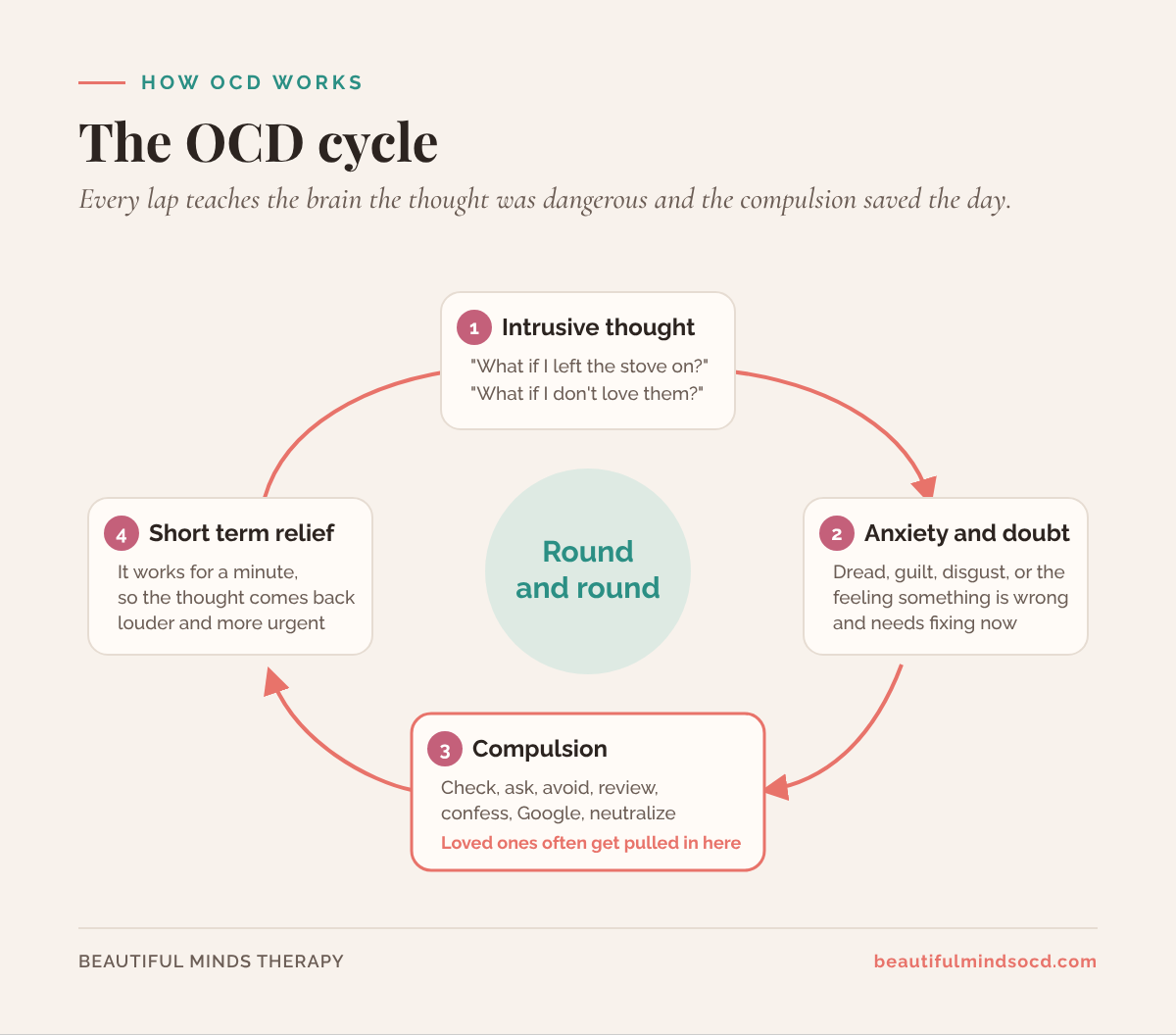
It goes like this. An intrusive thought pops up, something like "What if I left the stove on and the house burns down?" That thought brings a spike of anxiety, dread, or the gross feeling that something is wrong. To make the feeling stop, the person does a compulsion. They check the stove, ask you if you saw them turn it off, picture the knob in the off position, or just don't use the stove. The anxiety drops and they get relief.
The problem is what the brain learns from that relief. It learns that the thought was dangerous and the compulsion is what saved them. So the next time the thought shows up, it feels even more urgent, and the compulsion feels even more necessary. Over time the cycle gets faster and takes up more of the day.
Compulsions aren't always visible, either. Many happen in someone's head, like mentally reviewing a conversation, praying a certain way, counting, or arguing with the thought. Some are things they ask other people to do, and that's where you come in.
Where Loved Ones Get Pulled In: Family Accommodation
There's a clinical term for this that most people have never heard: family accommodation. It means the ways people around someone with OCD change their own behavior to reduce that person's distress. It's the most natural thing in the world, and almost everyone who loves someone with OCD does it.
Accommodation can look like answering the same reassurance question over and over, doing the checking for them, avoiding certain words, foods, places, or topics, waiting while rituals finish, washing your own hands extra, rearranging family routines, or taking over tasks they've started avoiding. Research has consistently linked higher levels of accommodation with more severe OCD symptoms. That doesn't mean you caused anything. It means that every time you step in to take the anxiety away, you become part of the compulsion, and the cycle gets fed a little more.
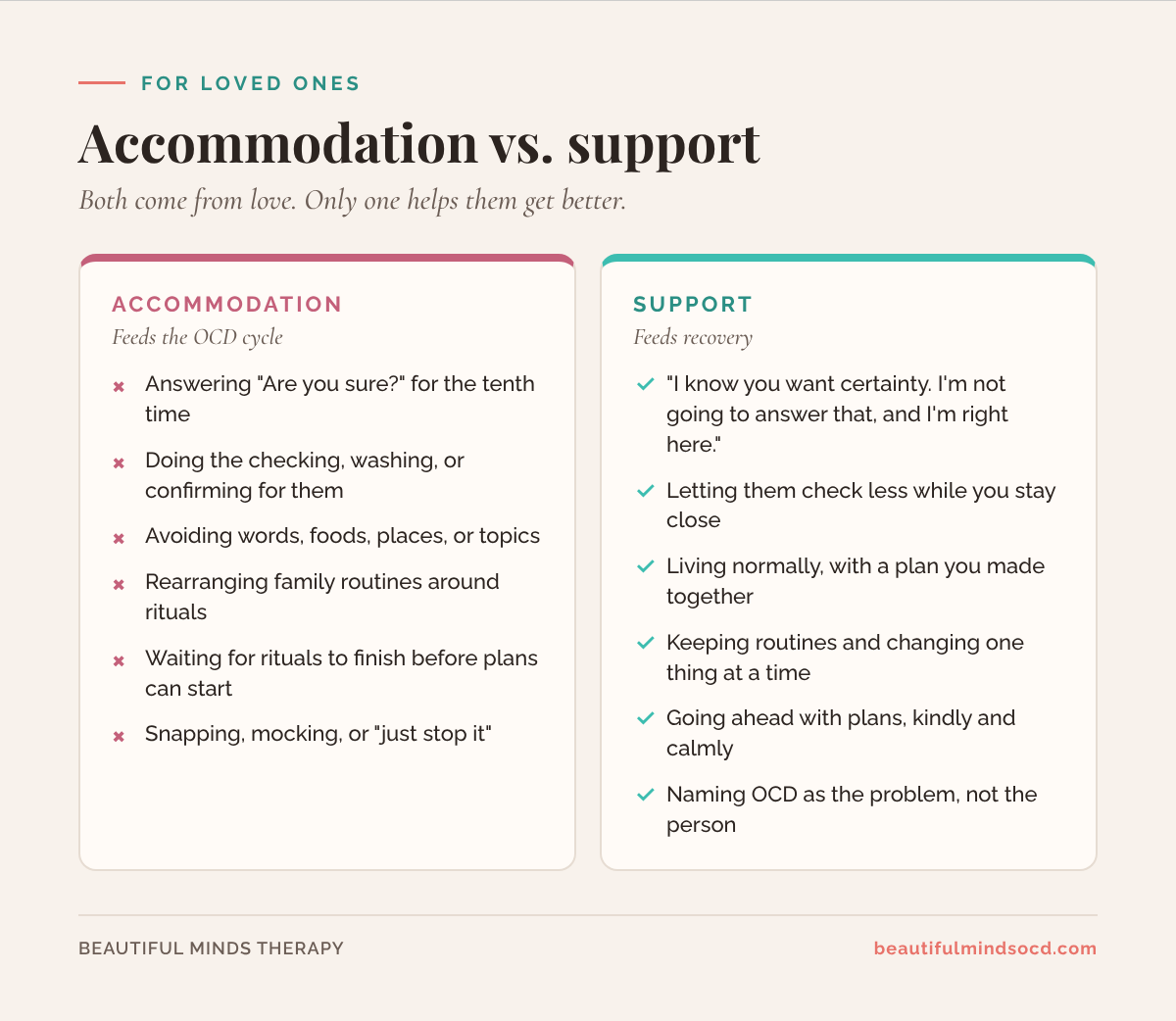
I want to be really clear about one thing. The answer is not to rip all of it away overnight. If you suddenly stop answering every question and refuse to help with anything, you'll mostly get panic, conflict, and someone who feels abandoned. The better approach is to pull back gradually, ideally with a plan you make together and with help from an ERP therapist. Pick one accommodation, talk about it ahead of time when everyone is calm, and practice changing that one thing.
Why Facing Fears and Sitting With It Actually Works
The treatment with the most research behind it for OCD is called Exposure and Response Prevention, or ERP. In plain English, it means gradually and deliberately facing the things OCD says to avoid, and then not doing the compulsion afterward. No checking, no asking, no mental reviewing, no neutralizing.
That sounds terrible, I know. Here's why it works.
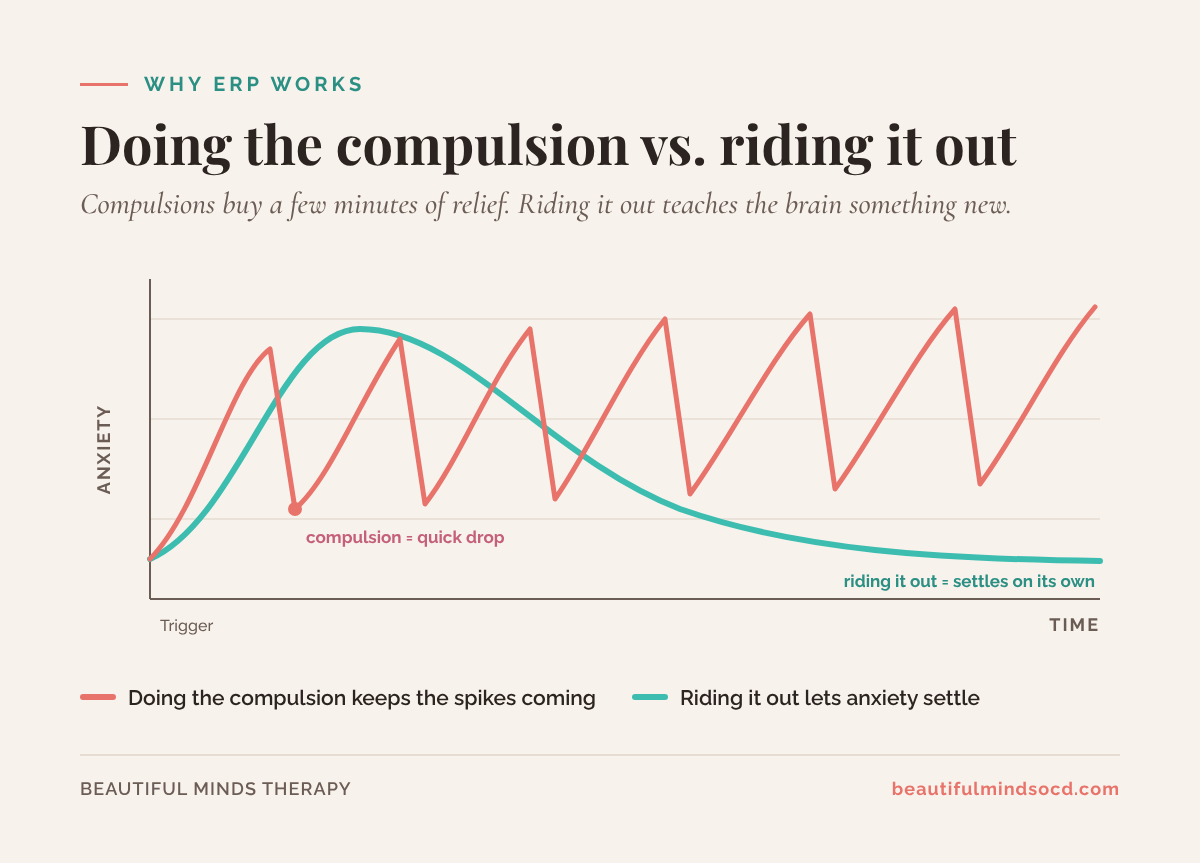
When someone does a compulsion, the anxiety drops fast, but it comes right back, and it often comes back bigger. When someone stays with the discomfort without doing anything to fix it, the anxiety usually rises, peaks, and then comes down on its own. Even when it doesn't come down as much as they'd like, they learn they can tolerate it. Each time they ride the wave, the brain collects evidence that the feeling is survivable and that they don't have to obey it.
The goal of ERP isn't to feel calm right away or to prove the fear wrong. Nobody gets a certificate saying the house will never burn down. The goal is to practice changing the response to fear, doubt, and discomfort, so OCD stops running the show. Some therapists also use ACT, which builds willingness to have uncomfortable thoughts and feelings without fighting them. Willingness doesn't mean liking the thoughts, agreeing with them, or giving up. It means making room for them so they don't get to make decisions.
Loved ones can play a real role here. Many ERP therapists, including me, invite family members or partners into a session or two so everyone learns what helps and what feeds the cycle. When the support system and the treatment plan are on the same page, progress tends to stick better.
What to Say Instead of Reassurance
This is the question I get most from loved ones. If I'm not supposed to answer the question, what am I supposed to say? Good news. You don't have to be cold. You just have to stop being the compulsion.
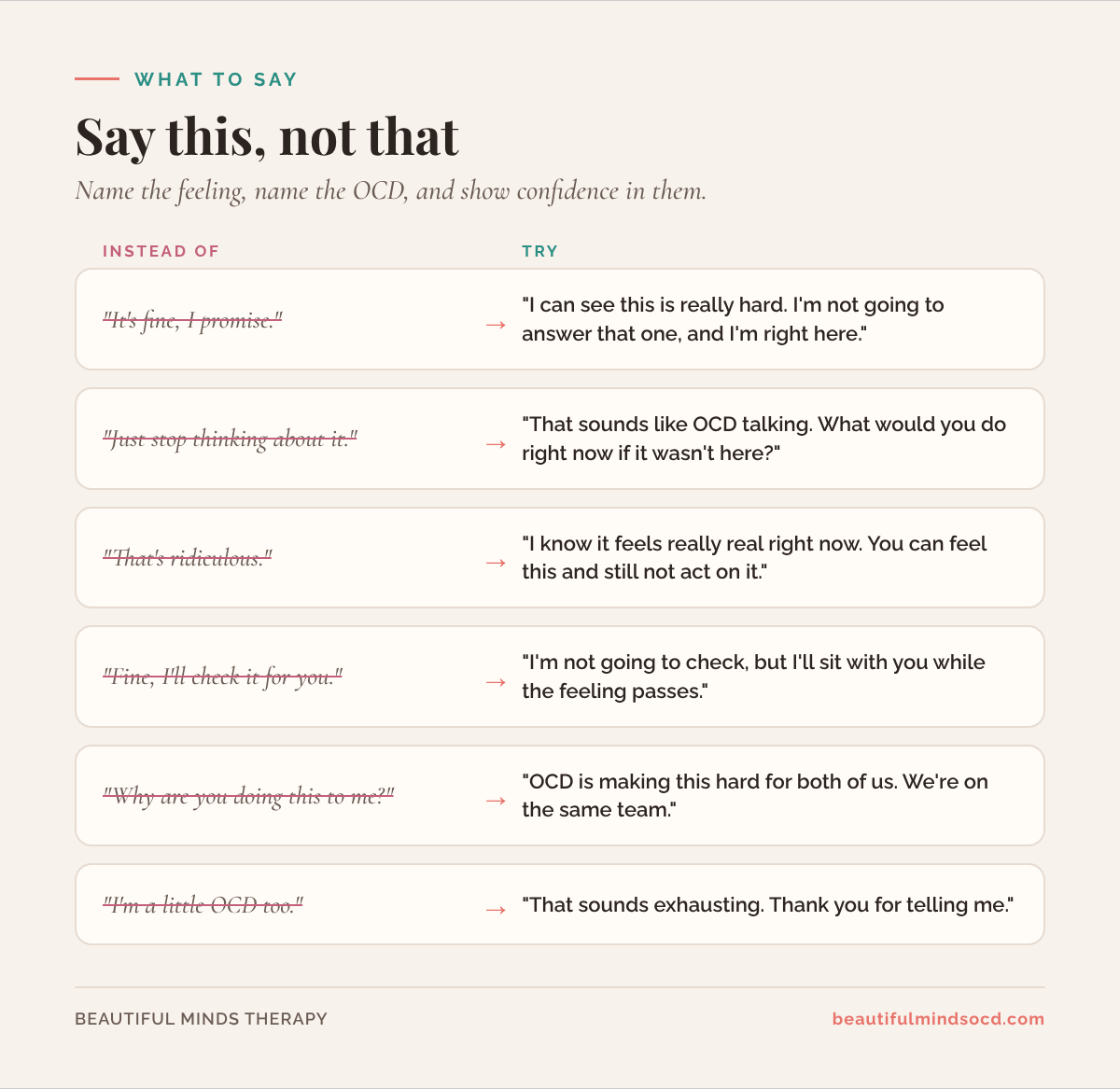
The formula is simple even when it's hard to do. Name the feeling, name the OCD, and express confidence in them. Something like, "I can tell you're really anxious right now. I think this is OCD asking for certainty, and I'm not going to answer it. I know you can handle this feeling, and I'm right here."
It helps a lot to agree on this language ahead of time. A phrase you both picked when things were calm, like "That sounds like an OCD question," lands much better in the moment than a brand new script out of nowhere.
What Not to Say
Most of the unhelpful things people say come from love or frustration, so if you've said these, you're in good company. Still, a few are worth retiring.
- "Just stop thinking about it." If they could, they would have done it years ago. Trying not to think a thought usually makes it louder.
- "That's ridiculous." They usually already know it doesn't make sense. Pointing it out adds shame without helping.
- "I'm a little OCD too." It shrinks something that may be eating hours of their day.
- "It's fine, I promise. Nothing bad will happen." This is reassurance. It feels kind and works for about four minutes.
- "Why are you doing this to me?" They aren't doing it to you. OCD is doing it to both of you.
What to Do in the Moment During a Spike
Theory is great until it's 11pm and someone you love is spiraling. Here's a simple plan for that moment.
- Slow yourself down first. Your calm is contagious, and so is your panic. Take a breath before you respond.
- Name what's happening without judgment. "It looks like OCD is really loud right now."
- Don't solve the content. You don't need to argue about whether the stove is on or whether they're a bad person. The content isn't the point. The cycle is.
- Offer presence instead of answers. "I'm not going to answer that, but I'll sit with you."
- Use the plan you made together. If you agreed on a limit, like one reassurance answer a day or a ten minute wait before checking, follow it gently.
- Talk about it later. Once things calm down, notice what helped and what didn't. Celebrate the times they rode it out, even a little.
One important note. If someone ever talks about wanting to act on a harmful thought, or talks about ending their life, that's different from OCD doubt and needs immediate help. Call or text 988, the Suicide and Crisis Lifeline, or call 911.
How It Shows Up Depending on Who You Are
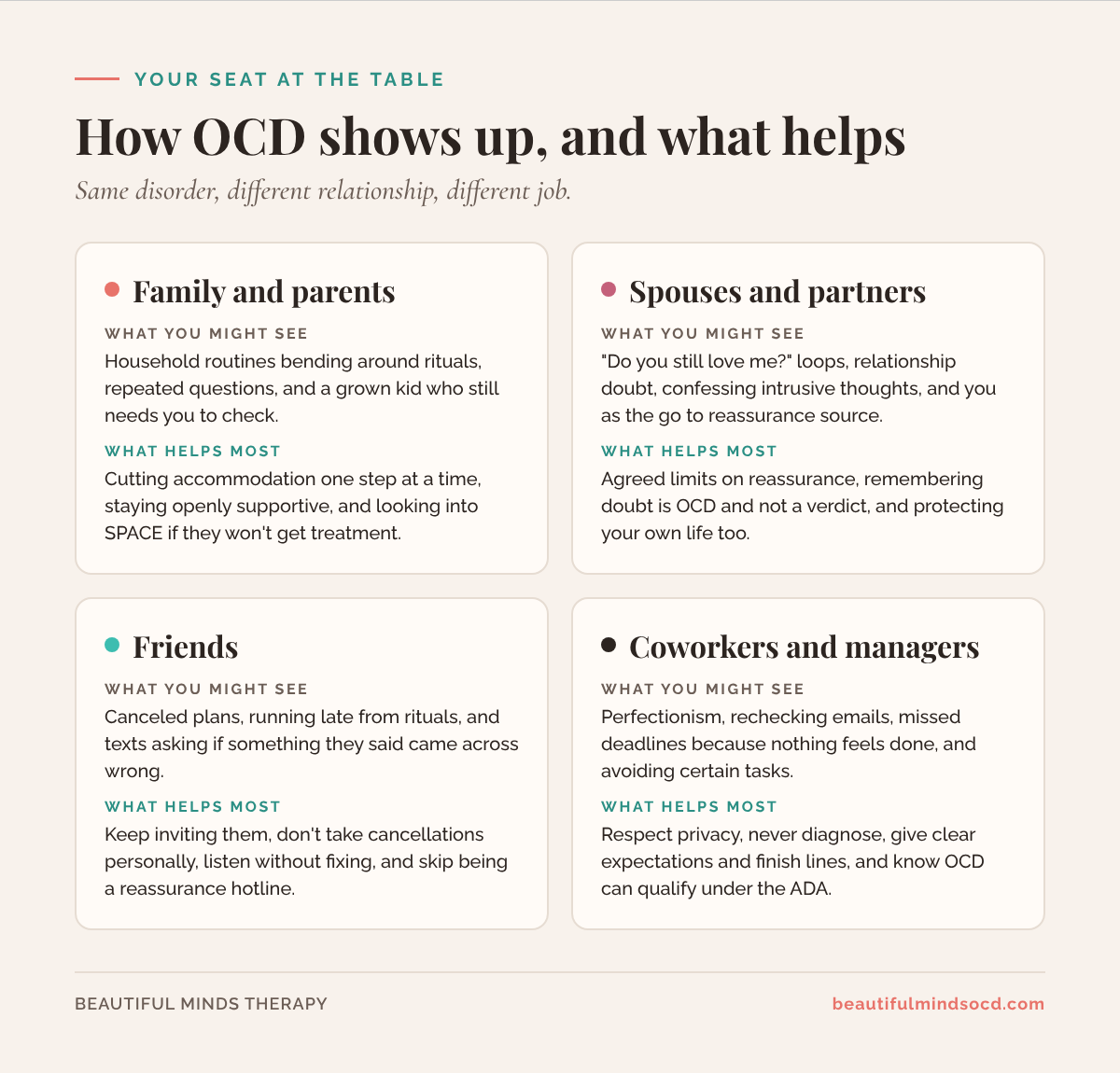
OCD looks a little different depending on your relationship with the person, and so does your role. Here's a quick map, and then we'll get into each one.
Parents and Family
Family members often carry the most accommodation because they share a home and a history. Parents especially tend to slip back into protector mode, even when their kid is 28 and has a mortgage.
If your adult child has OCD and won't get treatment, I know how helpless that feels. Here's the thing. You can't control their choices, but you can change your own responses. An approach called SPACE (Supportive Parenting for Anxious Childhood Emotions) was developed at Yale specifically for this. It works with parents rather than the person with OCD. It was built for parents of kids and teens, and its principles are now commonly used with parents of adult children too. The focus is on two things: being openly supportive and reducing accommodation, one step at a time. Parents can do this work even when their child isn't ready to.
Siblings and other relatives matter here too. They often feel resentment about how much the household revolves around OCD, or guilt for feeling that way. Both are worth talking about out loud.
Spouses and Partners
Partners get a front row seat to OCD, and sometimes they're the target of it. Relationship OCD (often called ROCD) shows up as constant doubt about whether they really love you, whether you're "the one," whether they're attracted enough, or whether you're secretly a bad match. It's painful to be on the other end of, because it can sound like a real relationship problem when it's actually OCD.
Partners also deal with confession compulsions. That's when the person with OCD feels like they have to tell you every intrusive thought, every attractive stranger they noticed, or every tiny thing they might have done wrong, so they can feel clean again. It can be confusing and hurtful. It helps to remember that the urge to confess is about getting rid of the doubt, not about the relationship.
The hardest part for partners is that you're both their closest support and the easiest source of reassurance. It's okay to set limits on how many times you'll answer "Do you still love me?" while also making it clear, through how you show up every day, that you're in it.
Friends
Friends usually see less of the day to day, which can be a gift. You get to be a piece of normal life. You might notice your friend cancels plans a lot, takes forever to leave the house, or texts you to ask if something they said came across wrong.
The most helpful things a friend can do are to keep inviting them, not take cancellations personally, and avoid becoming a reassurance hotline. If they open up about OCD, listen. You don't have to understand every detail to be a good friend. "That sounds exhausting. I'm glad you told me" goes a long way.
Coworkers and Managers
At work, OCD often hides behind perfectionism, rechecking emails, missed deadlines because nothing feels done, or avoiding certain tasks. People with OCD are often very capable and very conscientious, which is exactly why the checking gets so intense.
If you're a coworker, the most important rule is that disclosure belongs to the person with OCD. Don't diagnose your desk neighbor and don't share what they told you. If they do confide in you, keep it between you and treat them like the competent colleague they are.
If you're a manager, know that OCD can qualify as a disability under the Americans with Disabilities Act. Reasonable accommodations might include flexibility for therapy appointments, clear written expectations, or a defined finish line for tasks. The International OCD Foundation and the Job Accommodation Network (askjan.org) both have practical guidance. Focus on the work and on clear communication, not on the symptoms.
This Is Hard on Both Sides
Being the One With OCD
If you have OCD and you're reading this, you probably already feel guilty about how much it affects the people around you. Most people with OCD know their fears don't fully make sense, which can make asking for reassurance feel humiliating. You might hide compulsions, avoid telling people, or feel like a burden. On top of the anxiety itself, there's the exhaustion of fighting your own brain all day while trying to look fine.
That guilt is understandable, and it's also not very useful. The most helpful thing you can do for the people who love you is get effective treatment and let them be part of the plan.
Being the Support
If you're the support person, you're allowed to be tired. You're allowed to feel frustrated, resentful, scared, and confused, sometimes all before lunch. Caring about someone with OCD can take over your schedule, your home, and your own nervous system if you let it.
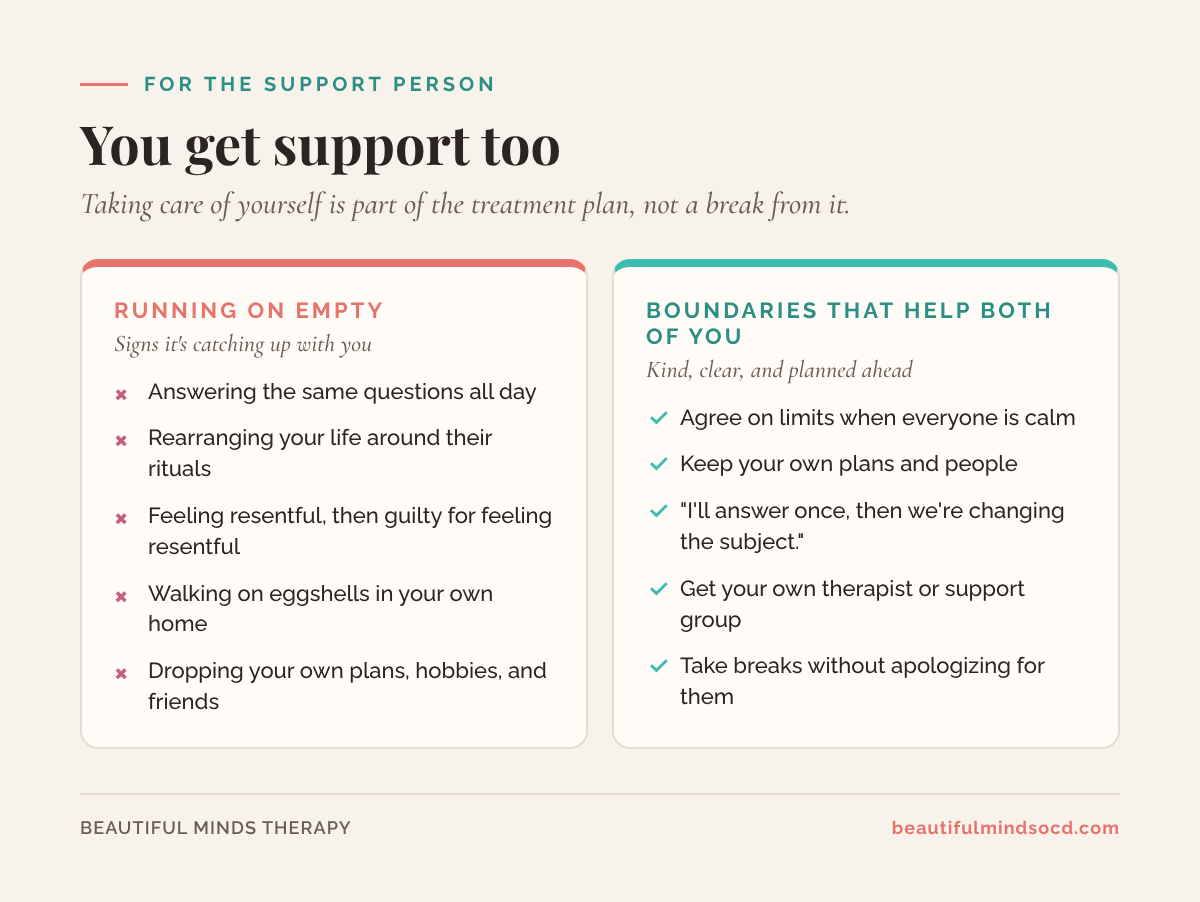
Boundaries are not punishments. A boundary like "I'll answer that question once, and then I'm going to change the subject" protects your relationship and supports their recovery at the same time. Keep your own plans, hobbies, and friendships. Find your own support, whether that's your own therapist, a family support group through the International OCD Foundation, or a friend who gets it. You can't pour from an empty cup, and frankly, OCD will happily drink whatever's left in it.
How to Encourage Treatment Without It Turning Into a Fight
Pushing someone into therapy rarely works. Here's what tends to go better. Pick a calm moment, not the middle of a spiral. Lead with what you've noticed and how much you care, not with a diagnosis. Something like, "I've noticed how much time the checking takes and how stressed you are. I've been reading about OCD, and there's a treatment that helps a lot. Would you be open to talking with someone who specializes in it?"
Specialization matters. General talk therapy can accidentally turn into another place to get reassurance. Look for someone trained in ERP. The International OCD Foundation has a directory at iocdf.org. If they aren't ready yet, that's okay. You can still work on your own accommodation, which often helps more than people expect.
Frequently Asked Questions
How do I help someone with OCD without enabling them?
Support the person, not the OCD. Stay warm and present, but gradually stop doing the compulsions for them, like answering repeated reassurance questions or checking on their behalf. Make a plan together ahead of time instead of pulling everything away at once.
Should I give reassurance to someone with OCD?
Reassurance usually works for a few minutes and then makes the doubt come back stronger. Instead of answering the question, acknowledge the feeling, name it as OCD, and let them know you believe they can handle the uncertainty.
What is family accommodation in OCD?
It's any change family members or partners make to reduce the person's OCD distress, like avoiding triggers, answering repeated questions, or joining in rituals. It comes from love, but research links more accommodation with more severe symptoms.
My partner has OCD. How do I cope?
Learn how the OCD cycle works, set limits on reassurance, protect your own life outside the relationship, and get your own support. If your partner is in ERP, ask whether you can join a session to learn how to help.
What can I do if my adult child with OCD refuses treatment?
You can change how you respond, even if they won't change yet. Look into SPACE, a parent focused approach that reduces accommodation while staying supportive. Many parents find their child becomes more open to treatment once the household stops revolving around OCD.
Can someone with OCD act on their intrusive thoughts?
OCD intrusive thoughts are unwanted and distressing, and they go against what the person values, which is why they cause so much anxiety. If you're worried, the best next step is an evaluation with an OCD specialist. If someone says they want to act on a harmful thought or is talking about suicide, get immediate help by calling or texting 988 or calling 911.
Is OCD a disability at work?
It can be. Under the Americans with Disabilities Act, people with OCD may be eligible for reasonable accommodations. The decision to disclose belongs to the employee.
What is ERP therapy?
Exposure and Response Prevention is the most researched treatment for OCD. It involves gradually facing feared thoughts or situations and practicing not doing compulsions, so the brain learns it can handle discomfort and uncertainty.
You Don't Have to Figure This Out Alone
Supporting someone with OCD asks you to do something that feels backwards: love them by not fixing it. That's hard, and you won't do it perfectly. Nobody does. What matters is learning the cycle, stepping out of it a little at a time, and taking care of yourself along the way.
I'm Brianne Birtic, LCSW, and I specialize in ERP for OCD, anxiety, panic, and phobias. I work with adults over telehealth in Wisconsin, Illinois, and Nebraska. I'm private pay and out of network only. I can provide superbills, but I can't guarantee reimbursement from your insurance.
If you or someone you love is ready to talk, the free 15 minute consult is a good place to start. It isn't a therapy session. It's a low key chance to ask the basics, get a feel for whether I'm the right fit, and decide if you want to move forward. No pressure, no homework.
Call (262) 683-4417, email Brianne@beautifulmindsocd.com, or visit beautifulmindsocd.com.
Want to talk it through with someone who gets it?
A free 15-minute consult is a low-pressure way to see if this is the right fit.
Book a Free Consult